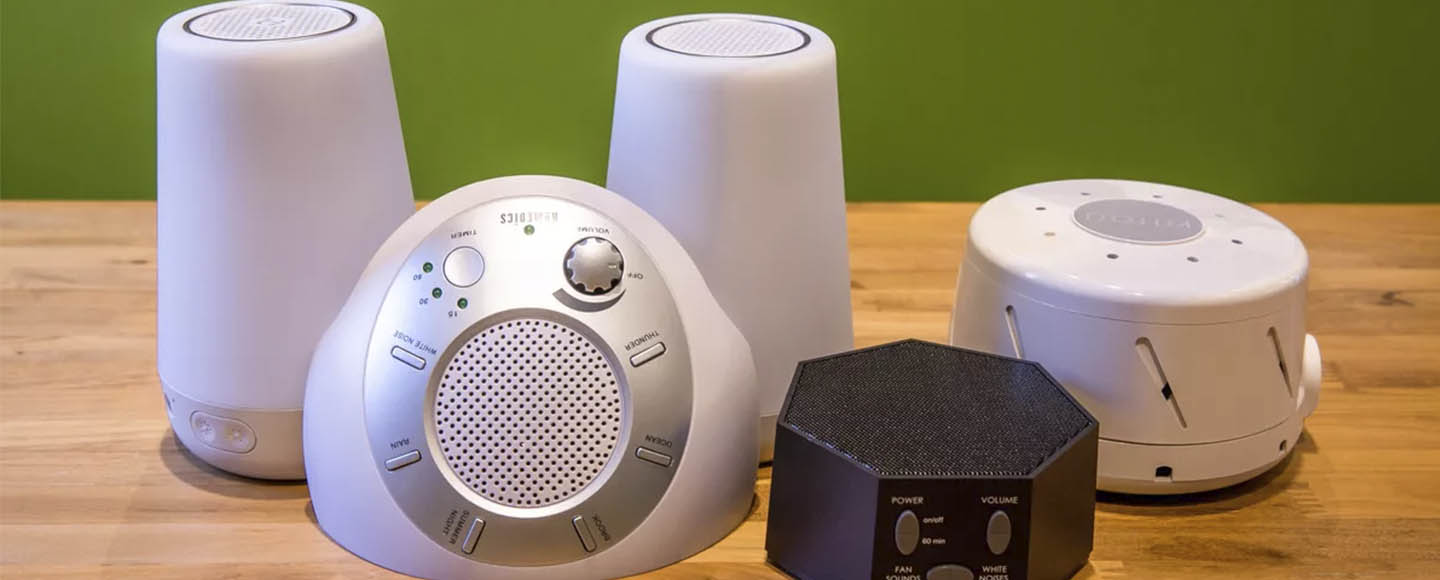
If you’re reading this at 2 a.m. next to a snoring partner, you already know the problem. The good news is you don’t have to just lie there and hope tonight is quieter. A white noise machine can help by covering up the sudden, uneven sound of snoring with something steadier and easier for your brain to tune out.
It’s worth setting expectations early: a white noise machine won’t stop snoring. It won’t fix the underlying cause. What it can do is make the snoring less noticeable, so falling asleep and staying asleep gets easier for many people.
Below, we cover our top picks, what to look for, and the science behind why some machines work better than others for this specific job.
Quick Summary: Our Top Picks
- Best overall: LectroFan EVO
- Best natural fan sound: Yogasleep Dohm Classic
- Best smart option: SNOOZ Smart Sound Machine
- Best budget pick: Dreamegg D3 Pro
- Best adaptive sound: Sound+Sleep SE
- Best for travel: LectroFan Micro2
- Best sound variety: Hatch Restore 3
Top 7 White Noise Machines for Snoring (2026 Reviews)
We looked at sound quality, volume range, low-frequency output, and how easy each machine is to use in the middle of the night. Snoring is a low, irregular sound, so we paid close attention to how well each machine handles bass-heavy noise, not just how loud it can get.
Best Overall
LectroFan EVO
What problem does it solve? Snoring that’s loud enough to need a machine with real headroom, not just a soft background hum.
Who is it best for? Light sleepers who need a wide volume range and want to fine-tune the sound rather than picking from a handful of presets.
What makes it different? The EVO leans on non-looping, fan-based and white/pink/brown noise generation instead of short looped recordings. That matters for snoring specifically, because looped tracks can develop an audible seam that your brain starts to notice, which defeats the purpose of masking.
Strengths
- Wide volume range, useful if your partner’s snoring varies night to night
- Multiple noise profiles, including deeper options that sit closer to snoring’s frequency range
- Simple controls that are easy to adjust without fully waking up
Limitations
- No smart app control
- Some sleepers find the interface a little dated compared with newer smart machines
Is it worth it? For most sleepers dealing with moderate to loud snoring, this is one of the strongest all-around options to consider.
Who should skip it? If you specifically want app control or a nightlight, look at the SNOOZ or Hatch Restore 3 instead.
Best Natural Fan Sound
Yogasleep Dohm Classic
What problem does it solve? A preference for real, mechanical fan sound over digitally generated noise.
Who is it best for? People who find synthetic white noise a little harsh or artificial and prefer something that sounds more like a real fan running in the next room.
What makes it different? The Dohm uses an actual internal fan rather than a speaker playing a recording. That naturally avoids the looping issue altogether, since a spinning fan doesn’t repeat in a fixed pattern the way a digital track can.
Strengths
- Genuinely non-looping sound, since it’s mechanical rather than digital
- Adjustable pitch by twisting the housing, which lets you shift the tone lower to sit closer to snoring frequencies
- No screens, no lights, minimal distraction
Limitations
- Lower maximum volume than some digital machines, so it may not be enough for very loud snoring
- Fewer sound options overall, since it’s built around one core fan sound
Is it worth it? In practice, for moderate snoring in a smaller bedroom, this is a solid and low-fuss choice.
Who should skip it? If your partner’s snoring is on the louder end, a higher-output digital machine like the EVO is probably a better fit.
Best Smart Option
SNOOZ Smart Sound Machine
What problem does it solve? Wanting fine control over the exact tone of the sound, adjusted from your phone instead of a dial on the unit.
Who is it best for? Couples who want to experiment with different tones to find what best covers a specific snoring pattern.
What makes it different? It combines a real internal fan with app-based tone adjustment, so you get the natural sound of a fan along with more precise control than a simple volume knob.
Strengths
- Real fan sound as the sound source, not a looped recording
- App control for adjusting tone without getting out of bed
- Built-in nightlight for middle-of-the-night trips to the bathroom
Limitations
- Requires a phone and a stable connection for full functionality
- Costs more than basic fan-based machines
Is it worth it? For couples who like to fine-tune settings, the added control can be worth the higher price.
Who should skip it? If you’d rather not manage another app before bed, a simpler machine like the Dohm Classic will serve you just as well.
Best Budget Pick
Dreamegg D3 Pro
What problem does it solve? Needing solid masking performance without paying for premium features you may not use.
Who is it best for? Shoppers who want reliable bass-heavy sound options without a big price tag.
What makes it different? It’s priced well below most of the machines on this list while still offering a reasonably deep, rich sound rather than a thin, tinny one.
Strengths
- Affordable compared with premium options
- Decent volume range for the price
- Portable enough to move between rooms
Limitations
- Build quality feels less premium than higher-priced machines
- Fewer advanced features, such as app control or adaptive volume
Is it worth it? If your priority is keeping costs down while still getting real masking benefit, this is worth considering.
Who should skip it? If you want smart features or adaptive volume, you’ll need to move up to a pricier option.
Best Adaptive Sound
Sound+Sleep SE
What problem does it solve? Snoring that changes in volume throughout the night, sometimes quiet, sometimes suddenly loud.
Who is it best for? Light sleepers whose partner’s snoring spikes unpredictably rather than staying at one steady volume.
What makes it different? It’s designed to respond to ambient sound and adjust its own volume, rather than staying fixed at whatever level you set before falling asleep.
Strengths
- Adaptive volume that can respond to louder snoring bursts
- Multiple deep, non-looping sound profiles
- Useful for sleepers who wake at sudden changes in sound rather than steady noise
Limitations
- Adaptive features add cost compared with a fixed-volume machine
- Some sleepers prefer a constant, predictable sound rather than one that shifts on its own
Is it worth it? Based on our evaluation, this is one of the better choices if inconsistent snoring is your specific issue.
Who should skip it? If your partner’s snoring is fairly steady, a fixed-volume machine will likely do the job for less money.
Best for Travel
LectroFan Micro2
What problem does it solve? Needing masking sound away from home, whether that’s a hotel room, a shared Airbnb, or a family visit.
Who is it best for? Frequent travelers who don’t want to give up their nighttime routine on the road.
What makes it different? It’s compact, USB-rechargeable, and can double as a small Bluetooth speaker, all while reaching a surprising volume for its size.
Strengths
- Small and light enough to pack easily
- Battery-powered, so it doesn’t need to stay plugged in
- Reaches a higher volume than its size suggests
Limitations
- Smaller speaker means somewhat less depth in the low end compared with larger machines
- Not the best pick as a primary at-home machine if you want maximum bass
Is it worth it? For most travelers, the convenience outweighs the smaller sound stage.
Who should skip it? If you want your main bedroom machine to also handle heavy snoring, choose one of the larger options instead.
Best Sound Variety
Hatch Restore 3
What problem does it solve? Wanting more than a single noise type, including the ability to layer sounds together.
Who is it best for? Sleepers who like to combine, say, a low fan hum with rain or ocean sounds rather than choosing just one.
What makes it different? It combines customizable sound layers, including pink and brown noise, with smart sleep routines like a sunrise-style light for waking up.
Strengths
- Layered, customizable sound combinations
- Includes brown and pink noise, useful for masking low-frequency snoring
- Smart routines for winding down and waking up
Limitations
- Higher price than most machines on this list
- More features to learn than a simple one-button machine
Is it worth it? If you want variety and don’t mind the price, this is worth considering.
Who should skip it? If you just want a straightforward, no-frills sound machine, a simpler option will save you money.
White Noise Machines for Snoring Compared
| Machine | Best For | Sound Type Strength | Power Source | Relative Price | CTA |
|---|---|---|---|---|---|
| LectroFan EVO | Overall use, moderate to loud snoring | Wide range, non-looping digital noise | AC | Mid-range | Check Price |
| Yogasleep Dohm Classic | Natural fan sound | Real mechanical fan, adjustable pitch | AC | Mid-range | Check Price |
| SNOOZ Smart Sound Machine | App-controlled fine-tuning | Real fan with adjustable tone | AC | Higher | Check Price |
| Dreamegg D3 Pro | Budget shoppers | Decent bass for the price | AC/USB | Budget | Check Price |
| Sound+Sleep SE | Unpredictable snoring volume | Adaptive, deep noise profiles | AC | Higher | Check Price |
| LectroFan Micro2 | Travel | Compact but still fairly loud | USB/battery | Mid-range | Check Price |
| Hatch Restore 3 | Sound variety and layering | Custom layered sounds, brown/pink noise | AC | Higher | Check Price |
Use this table as a starting point, then read the section below on placement and sound type, since the “best” machine really depends on how your bedroom is set up and how loud the snoring actually is.
How White Noise Works Against Snoring
Masking vs. Drowning Out
People often ask whether a white noise machine will “drown out” snoring. That phrase is a little misleading. The machine isn’t removing the sound of snoring from the room. What it’s actually doing is masking it, meaning it adds a steady background sound that makes the snoring less noticeable by comparison.
Here’s the difference in plain terms:
- Elimination would mean the snoring sound is gone. A white noise machine doesn’t do this.
- Masking means the snoring is still happening, but it blends into a steadier backdrop of sound instead of standing out.
- Drowning out is really just a stronger form of masking, where the background sound is loud enough that the snoring becomes very hard to pick out.
In most cases, masking is genuinely achievable. Full elimination of the sound is not, no matter how loud you turn the machine up.
White Noise vs. Pink Noise vs. Brown Noise for Snoring
This is one of the most overlooked parts of choosing a machine, and it matters more for snoring than for almost any other use case.
White noise contains a broad, fairly even mix of frequencies, a bit like static. It works well for many general masking needs, but snoring is a low, irregular sound, and standard white noise doesn’t always sit at the same frequency range.
- White noise: Even distribution across frequencies. Good general-purpose masking, but can feel a bit “hissy” for some sleepers.
- Pink noise: Weighted more toward lower frequencies than white noise, with a softer overall feel. Often described as sounding more like steady rainfall.
- Brown noise: Weighted even further toward deep, low frequencies. This is the closest match to the low rumble of snoring, which is why many sleep sound experts point toward brown noise or deep fan sounds specifically for snoring.
If your priority is masking a deep, rumbling snore, brown noise or a real mechanical fan (like the Dohm) will often outperform a thinner, higher-pitched white noise track. If the snoring is quieter or higher-pitched, standard white noise may be all you need.
When White Noise Works Best (and When It’s Not Enough)
White noise tends to work well when:
- The snoring is moderate rather than extremely loud
- The machine is placed reasonably close to the listener
- The background sound is consistent, without obvious loops or gaps
- The volume is loud enough to cover the snoring without being uncomfortable
It’s less effective when:
- The snoring is very loud or happens right next to your ear
- The bedroom is large and the machine is placed far away
- The machine’s sound is thin or lacks low-frequency depth
Safety and Volume: How Loud Is Too Loud?
It’s tempting to just turn the volume all the way up, but there’s a real trade-off between effective masking and long-term hearing comfort.
- Many sleep specialists suggest keeping machine volume at or below roughly 60–65 decibels measured at pillow height, which is close to the volume of normal conversation.
- Running a machine near maximum volume all night, every night, especially placed close to your ear, isn’t something we’d recommend as a long-term habit.
- If you find you need to run a machine near its loudest setting just to mask the snoring, that’s often a sign the issue is placement or sound type rather than needing more raw volume. Adjusting where the machine sits, or switching to a deeper brown-noise profile, can make more difference than cranking the dial further.
Results vary depending on your bedroom size, your mask type of machine, and how loud the snoring is to begin with, so treat these numbers as a general guide rather than a hard rule.
Optimal Placement Guide: Where to Put Your Machine
Placement can matter as much as which machine you buy.
Distance From the Sleeper vs. Distance From the Snorer
There are two ways to think about placement:
- Close to the listener: Placing the machine near the person who’s bothered by the snoring tends to be the most efficient approach, since you don’t need as much volume to be effective.
- Between the two of you: For couples, placing the machine roughly between the snorer and the listener can help create a more even wall of sound, though this works best in smaller rooms.
Placement for Couples: Bedside vs. Center Room
If your bedroom is small to medium-sized, a bedside placement near the listener is usually simplest and most effective. In a larger room, or if you want the sound to feel more evenly distributed, a central placement, such as on a dresser between the bed and the door, can work better.
A few practical tips:
- Keep the machine on a stable, flat surface at roughly ear height when lying down, if possible.
- Avoid placing it directly against a wall or inside a cabinet, since that can muffle the sound.
- If you share a room with two different sensitivities to sound, you may need to experiment with a slightly more central spot rather than favoring one side.
Should the Machine Be Next to Your Bed?
For most people, yes, this is the simplest and most effective placement. Because you don’t need to fill the whole room with sound, just the space immediately around your head, a bedside table or nightstand tends to work well. One drawback is that a machine sitting only a foot or two from your ear can feel loud even at lower volume settings, so you may need less volume than you’d expect.
Should You Put It Between You and Your Partner?
This can work well in smaller bedrooms, since it treats the space between the two of you almost like a sound buffer. In a larger room, though, the sound has to travel further to reach either person, which often means turning the volume up more than you would with a bedside placement, and that brings you closer to the volume limits mentioned earlier.
Should You Put a White Noise Machine Across the Room?
Placing the machine far from the bed, for example on a dresser near the door, generally isn’t the most efficient option for masking snoring specifically. It can still add some general ambient sound to the room, but you’ll usually need a louder, more powerful machine to get the same masking effect you’d get from a quieter machine placed closer to the bed.
Buyer’s Guide: What to Look for When Snoring Is the Problem
Volume and Decibel Capability
This is one of the most important specs for snoring specifically. A machine that tops out at a fairly quiet volume may be fine for general background noise, but it may not have the headroom to handle a genuinely loud snorer. Look for a wide volume range rather than judging by maximum volume alone.
Low-Frequency Output
As covered above, snoring tends to be a low, rumbling sound. A machine with strong bass-heavy or brown-noise output will generally mask it more effectively than one built mainly around thinner, higher-pitched tones.
Non-Looping Audio
Digitally generated sound sometimes uses a short recording that repeats on a loop. Over time, your brain can start to notice the repeating pattern, which makes the sound more distracting rather than less. Machines that use continuous digital synthesis or a real mechanical fan avoid this problem.
Sound Options
More sound choices aren’t automatically better. What matters is having a few genuinely useful options, ideally including at least one deep, low-frequency profile, rather than a long list of nature sounds you’ll never use.
Timer and Continuous Play
Some sleepers prefer the machine to run all night, while others like it to shut off after they’ve fallen asleep. Either can work, but a timer that shuts off partway through the night risks the snoring becoming noticeable again later, so continuous play is often the safer default for this specific use case.
Size and Portability
If you travel often, a smaller, battery-powered option is worth prioritizing, even if it means giving up a bit of low-end depth.
Power Source
AC-powered machines tend to have the most consistent volume and sound quality. USB and battery-powered options add flexibility for travel but may have a lower maximum volume.
Ease of Use at Night
Nighttime controls should be simple enough to adjust half-asleep. A single volume dial or a couple of large buttons is often more practical at 3 a.m. than a phone app, even if the app offers more precise control when you’re fully awake.
Alternative Options: White Noise vs. Earplugs vs. Anti-Snoring Mouthpieces
A white noise machine isn’t the only option, and it isn’t always the best fit for everyone.
White noise machine vs. earplugs
- Works well if you don’t like anything in your ears overnight.
- Easier for a couple to share the same solution, since one machine covers both people.
- Foam or wax earplugs for sleeping with a snorer typically provide greater raw sound reduction than masking alone, so for very loud snoring, some people combine both.
White noise machine vs. noise-canceling earbuds
- Noise-canceling earbuds can be effective, but comfort while lying on your side is a common complaint.
- Battery life is a real limitation for all-night use.
- A white noise machine avoids the comfort and battery issues entirely, since nothing needs to be worn.
White noise machine vs. a regular fan
- A standard box fan or oscillating fan can offer similar masking benefits to a fan-based white noise machine, often for less money.
- The trade-off is airflow: a fan blowing directly on you all night can dry out your throat or feel too cold in winter, which a dedicated white noise machine avoids.
- Standalone white noise machines also tend to offer more sound options and a more consistent tone than a fan repositioned from another room.
Anti-snoring mouthpieces
These target the cause of snoring rather than the sound of it, which is a fundamentally different approach. They can reduce or eliminate snoring for some people, but they involve a learning curve, aren’t comfortable for everyone, and won’t help at all with snoring caused by conditions like sleep apnea without medical guidance. For many couples, a white noise machine is the simpler starting point, with an anti-snoring mouthpiece or medical consultation as a next step if the snoring is severe.
Combining white noise with earplugs
For particularly loud snoring, combining a moderate white noise machine with comfortable earplugs can work better than either approach alone. The machine handles general masking, while the earplugs take the edge off the loudest peaks.
Frequently Asked Questions About White Noise Machines and Snoring
Will a white noise machine drown out snoring?
Not entirely. It can make snoring far less noticeable by adding a steady background sound, but it doesn’t physically remove the sound the way earplugs or distance would. Think of it as masking rather than elimination.
Does a white noise machine help with snoring?
For many sleepers, yes. It helps with the perception of snoring by making the sudden, irregular sound blend into a more consistent background, rather than addressing the snoring itself.
Do white noise machines drown out snoring?
The wording here is a bit misleading. “Drowning out” suggests the sound disappears, but what’s actually happening is masking, where a strong, consistent background sound reduces how noticeable the snoring is.
What is the best white noise machine for a snoring partner?
Based on our evaluation, the LectroFan EVO is the strongest all-around pick, thanks to its wide volume range and non-looping, bass-capable sound options. If you specifically want a real mechanical fan sound, the Yogasleep Dohm Classic is worth considering instead.
What is the best sound machine for snoring?
It depends on the type of snoring. For a deep, low rumble, brown noise or a real fan-based machine typically performs better than standard white noise. For lighter or higher-pitched snoring, standard white noise is often enough.
Is snoring white noise?
No. White noise contains a broad, fairly even spread of frequencies. Snoring is an irregular biological sound that changes in pitch and volume from breath to breath. They’re different types of sound, which is exactly why a steady white noise (or brown noise) source can help mask the uneven pattern of snoring.
Where is the best place to put a white noise machine?
For most couples, placing it near the person bothered by the snoring, on a stable surface at roughly ear height, works best. In larger rooms, a more central placement between the two sleepers can help.
Is it better to use white noise or brown noise for snoring?
For deep, low-frequency snoring, brown noise generally performs better, since it’s weighted toward the same low frequency range. For lighter snoring, standard white noise is often sufficient.
Can a white noise machine stop someone from snoring?
No. It only affects how noticeable the sound is to the listener. It has no effect on the snorer’s breathing or the cause of the snoring itself.
Final Verdict: What Is the Best White Noise Machine for Snoring?
If your biggest issue is a partner whose snoring is loud and inconsistent, the LectroFan EVO’s wide volume range and deep noise options make it one of the strongest choices to consider first. If you’d rather have a genuinely natural fan sound with no digital looping at all, the Dohm Classic remains a dependable, lower-cost alternative.
Free Guide
Get Our Snoring Solutions Checklist
Struggling to find the right solution for a snoring partner? We’ve compiled a free, printable checklist to help you compare white noise machines, earplugs, and anti-snoring devices side-by-side.
Ready to Sleep Quietly?
Stop fighting through the night and get the rest you deserve. Check the latest prices and availability for our top recommended white noise machines to find the perfect fit for your bedroom.